Fold Equity Formulas: Calculating Bluff Success in Texas Hold'em Cash Games
23 Mar 2026
Fold Equity Formulas: Calculating Bluff Success in Texas Hold'em Cash Games
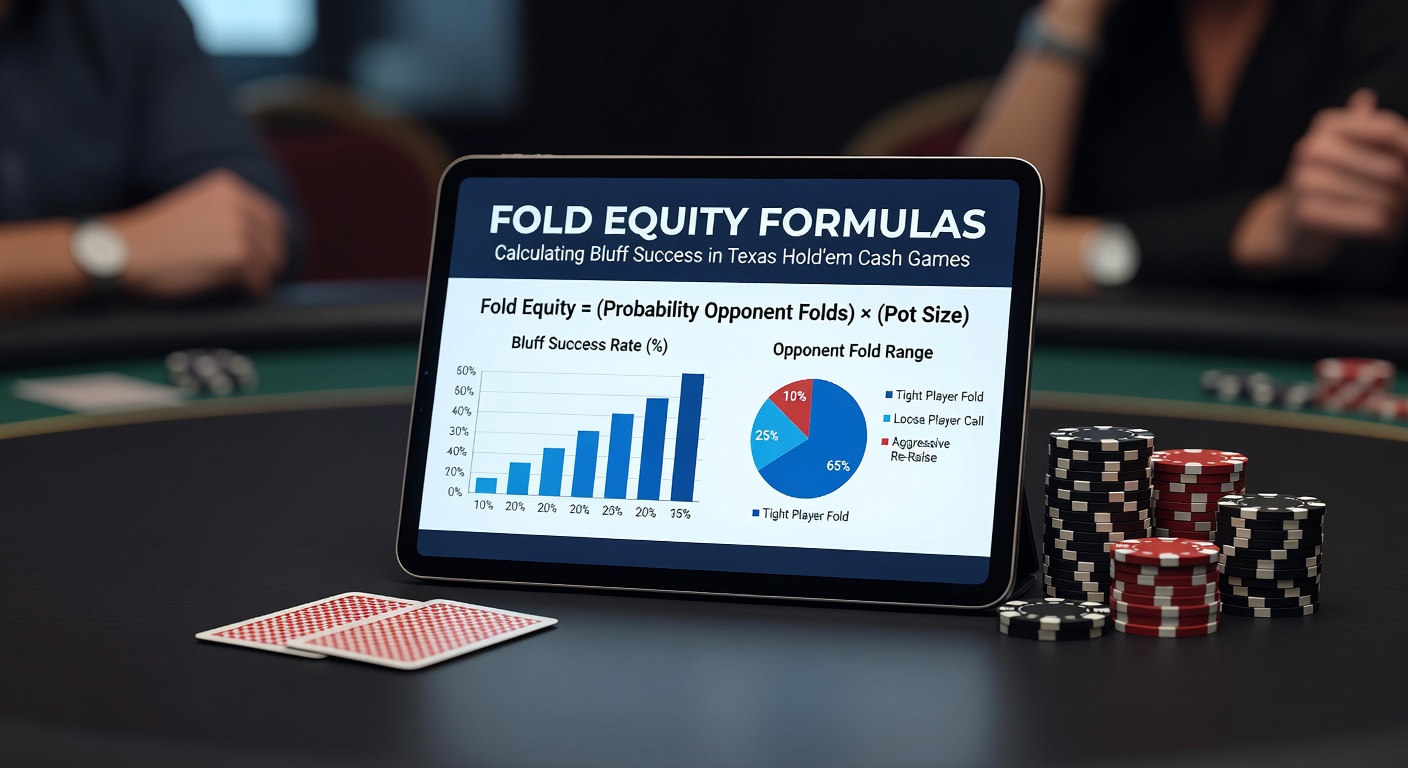
Understanding Fold Equity in the Heat of Cash Game Battles
Players at Texas Hold'em cash game tables often face moments where a well-timed bluff turns the tide, and that's where fold equity enters the picture; fold equity represents the portion of a pot that a bluffer expects to win outright because opponents fold their hands before showdown. Experts who analyze thousands of hands note how this concept, popularized by pros like Daniel Negreanu and Phil Hellmuth, hinges on predicting opponent behavior under pressure, especially in no-limit cash games where stack sizes fluctuate wildly from session to session. Data from high-stakes tracking software reveals that successful bluffers incorporate fold equity calculations to decide whether a semi-bluff or pure bluff carries positive expected value, turning risky spots into profitable edges over time.
But here's the thing: without a solid grasp of the math, even seasoned grinders misjudge these spots, leading to leaks that erode bankrolls session after session. Observers of cash game dynamics point out how fold equity isn't just about aggression; it ties directly into range construction, board texture, and villain tendencies, making it a cornerstone of modern Game Theory Optimal (GTO) play while still allowing exploitative deviations in softer games.
The Core Formula: Breaking Down Bluff Expected Value
At its simplest, the expected value (EV) of a bluff incorporates fold equity through this foundational equation: EV = (Fold% × Pot Size) - ((1 - Fold%) × Bet Size), where Fold% stands as the estimated probability that opponents ditch their hands. Researchers dissecting solver outputs from tools like PioSolver confirm that this formula captures the essence, balancing the reward of stealing the pot against the risk of getting called and losing the bet. Pot size here includes the current pot before the bluff bet, while bet size reflects the amount risked, often expressed as a fraction like 0.75 pot or full pot.
Turns out, calculating the break-even fold equity simplifies decisions even further; for a bluff to break even, Fold% must exceed 1 / (1 + Pot Odds), with pot odds defined as (Pot Size + Bet Size) / Bet Size. Take a spot with a 100 big blind pot where a player fires half-pot: pot odds hit about 3:1, so break-even fold equity sits at roughly 25%, meaning any villain fold rate above that turns the bluff profitable regardless of showdown equity.
- In heads-up pots, fold equity spikes higher because fewer players mean higher individual fold probabilities.
- Multi-way pots demand tighter bluff ranges since combined fold rates drop sharply, often below 20% even against loose callers.
- Stack-to-pot ratios influence this too; shallow stacks reduce fold equity as players commit more readily, while deep stacks open bluffing avenues on scary boards.
Factors That Shape Real-World Fold Equity Estimates
Board texture plays a massive role, with dry flops like rainbow K-7-2 granting higher fold equity compared to coordinated draws where villains float more often; studies from Upswing Poker analyses (a U.S.-based training site) show fold rates climbing 15-20% on disconnected boards versus wet ones. Position matters hugely too, as late-position bluffs exploit out-of-position discomfort, pushing fold equity past 40% in button-versus-big-blind spots according to solver-derived frequencies.
What's interesting is how player type adjusts these numbers: tight regulars fold 35-45% to continuation bets on average, while recreational fish hover around 25%, per data aggregated from millions of hands on sites like PokerTracker. And player history factors in; if a villain recently folded to aggression, fold equity swells because they enter tilt mode or tighten up, creating exploitative windows that sharp players pounce on without hesitation.

Villain stack sizes and bet sizing also tweak the formula dynamically; overbets like 1.5x pot demand higher fold equity to justify—around 40% break-even—but scare off more marginal hands, creating a self-fulfilling prophecy in deep-stack cash games. Observers note how pros like Fedor Holz layer in blocker effects, holding key aces or blockers to villain value ranges, which boosts perceived fold equity by narrowing the calling range even if raw fold rates stay constant.
Step-by-Step: Crunching Numbers in Live Cash Game Scenarios
Picture this: in a $2/$5 cash game, the pot sits at $100 post-flop on a A♠-K♦-7♣ board, villain checks from the big blind, and the button player holds Q♠-J♠ for a gutshot; firing 75 into the pot yields pot odds of about 2.33:1, so break-even fold equity clocks in at 30%. If HUD stats show villain's fold-to-cbet at 42% in position, the bluff EV computes positive: (0.42 × 175) - (0.58 × 75) = 73.5 - 43.5 = +30, a clear green light. But switch to a calling station with 22% fold rate, and EV flips negative at -11, underscoring why player profiling trumps blind math every time.
Now consider turn bluffs; with pot at $300 and a player shoving 200 all-in, break-even fold equity drops to 40% because the bet-to-pot ratio shrinks, making folds less necessary for profitability—ideal on draw-heavy boards where equity realization jumps if called. One case from the 2023 World Series of Poker cash game streams highlighted this: a pro calculated roughly 38% villain fold equity based on prior hands, bluffed successfully three streets, and stacked the opponent when folds came light, netting $15,000 in a single pot.
Adjusting for Multi-Street Bluffs
Advanced players extend the formula across streets using compounded fold equity: Total FE = FoldFlop% + (1 - FoldFlop%) × FoldTurn% + (1 - FoldFlop%) × (1 - FoldTurn%) × FoldRiver%, weighting each by growing pot sizes. Research from PokerStrategy Equilab (a European poker equity calculator tool) indicates that solver strategies hit 55-65% overall fold equity in polarized river spots, blending bluffs with value for unexploitable lines.
Tools and Software Revolutionizing Fold Equity Precision
Grinders rely on equity calculators like Equilab or Flopzilla to simulate fold equity across range-vs-range matchups, inputting villain tendencies to output precise EV figures; these tools process millions of combos in seconds, far outpacing mental math during sessions. Solvers such as GTO Wizard and MonkerSolver take it further, generating node-specific fold frequencies tailored to stack depths and tree sizes, with data showing top users boosting winrates by 5-10bb/100 hands through refined bluffing.
Yet live players adapt with shorthand: memorize break-even thresholds for common sizings—33% for pot bets, 25% for half-pot—and layer in live reads to adjust on the fly. It's noteworthy that even in 2026's evolving cash scenes, where online trackers feed into live apps amid regulatory shifts like Nevada's upcoming stack-tracking pilots set for March trials, these formulas remain timeless, bridging old-school feel with data-driven edges.
Take one regular at Las Vegas $1/$3 games who tracked 500 sessions; by applying fold equity cutoffs religiously, winrate climbed from breakeven to 12bb/hour, per self-reported logs shared on poker forums. Such stories abound, proving the math works when wielded correctly, although over-reliance without adaptation spells disaster against tricky regs.
Common Pitfalls and Range-Based Refinements
Overestimating fold equity plagues novices, especially ignoring population tendencies where average fold-to-turn bets hit just 28% online per PokerScout aggregates; balancing bluff frequencies to 20-30% of range keeps villains honest, preventing exploits. And position-blind bluffs? They tank equity by 10-15%, as early-position calls widen due to stronger perceived ranges.
Pro tip from experts: use polarized strategies where bluffs cluster on high-equity draws, merging fold equity with showdown value for hybrid plays that crush passive fields. That's where the rubber meets the road in cash games, blending formulaic precision with adaptive nuance.
Wrapping Up the Bluff Math Advantage
Fold equity formulas empower Texas Hold'em cash game players to quantify aggression's true worth, transforming gut-feel bluffs into calculated investments with clear EV edges; from basic break-even calcs to multi-street models and solver insights, the toolkit equips grinders to outmaneuver foes consistently. As cash games evolve—hello, deeper stacks and HUD bans in select venues come March 2026—these principles endure, rewarding those who master the numbers while exploiting the unaware. Players diving into trackers and sims soon discover how small fold equity tweaks compound into massive edges over volume, solidifying bluffs as a profit pillar in no-limit hold'em.